Back to School: A Brief History of the Kitchen
This month marks the return to school, classrooms back to bustling and playgrounds raucous so we thought this is the perfect time to give our own little lesson in the history of the kitchen!
I’m not a historian (shocker) and this subject is absolutely immense, but I hope you enjoy this chance to step back in time and chronologise some significant moments in how kitchens have evolved…

Pluck-Kitchen-History-18
King Henry VIII's kitchen at Hampton Court Palace

Pluck-Kitchen-History-17
18th Century Saltram House Kitchen
Pluck-Kitchen-History-20jpg
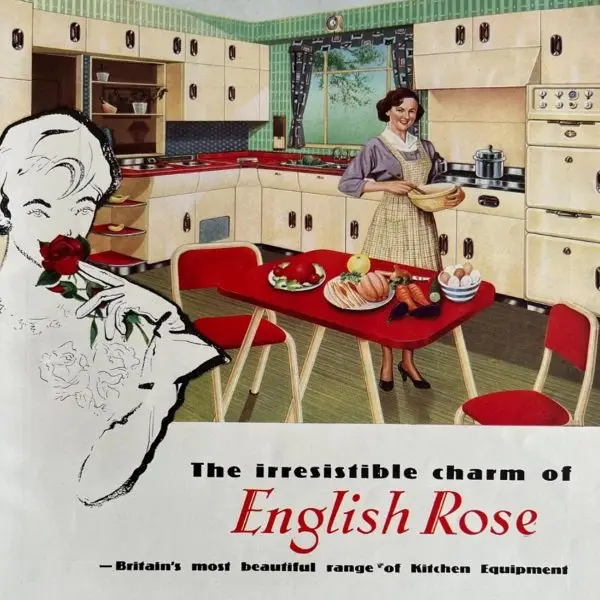
20th Century 'English Rose' Kitchen Advert
Fire and Foraging
For several hundred years, the average cooking set-up did not change a great deal. Can this one room be called a kitchen?! Discuss…
‘The kitchen came from very humble beginnings in the Middle Ages, where peasants lived in one room which served as a room for cooking, eating and general living. The kitchen really consisted of a hearth stone, a smoky wood fire with a pot on top and a wooden spoon. This was used from as far back as the Saxons right up to the time of the Tudors…Food was foraged so the diet was seasonal and quite limited. Bread was not cooked at home but in the oven of the Lord of the Manor along with the bread of all of the other peasants.’ explains The Victorian Emporium.
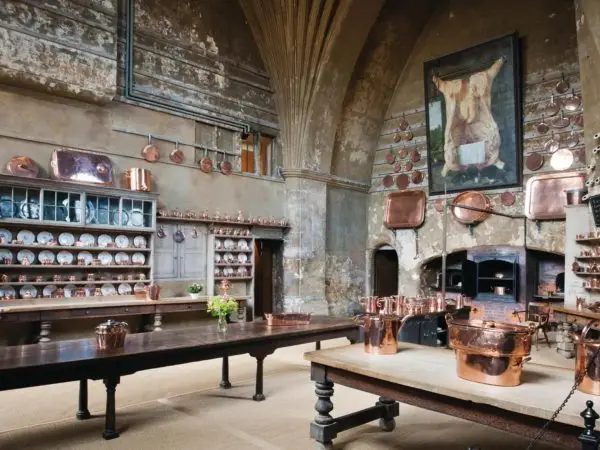
The kitchens in the wealthy, bread baking households often had several huge fireplaces and spits for cooking and roasting meat. They would be separate from the Great Hall, the main space to host and show off your power and status, reflecting the vernacular architecture of the day, decorated with works from the favoured tapestry weaver or painter.
Stuart Kitchens and Coal
The major development during this era was the introduction of coal as a cooking fuel, in part precipitated by wood shortages. Open hearths were inefficient for burning coal, which requires a concentrated updraft to stay lit, so these were redesigned. Over the course of the 17th century, the open hearth began evolving into early versions of the enclosed iron range to better manage coal’s intense, concentrated heat.
Food tasted different, cooking was easier with less smoke and time was freed up as the laborious task of keeping a wood fire burning was no longer needed…but only for servants in the wealthiest households at this point.
The scents emanating from grand kitchens were changing too as new flavours and cooking fads were embraced. France was considered a bastion of culinary excellence.
Georgian Furniture and Cast Iron Ranges
The emergence of the middle-class merchants is when the typical domestic set-up starts to shift significantly. Emulating noble houses, kitchens are downstairs out of sight. Cooking, food prep and storage separated with sculleries and pantries. The aristocratic notion that kitchens were best avoided, cooking and the rest, is servants’ work was embraced by those making enough money to do so.
The coal revolution continues and contributes to the invention of the first ever range cooker at the very end of this period in 1829 by William Flavel. A huge change, goodbye to open-fire cooking, hello to hob rings and an oven in a single iron unit, though only available to the wealthiest people to begin with…
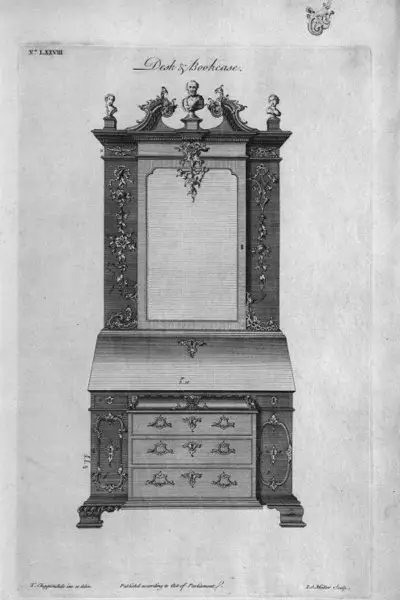
This is the time when furniture makers became famous and sought after for their craft, with workshops that employed hundreds of skilled craftsmen. Thomas Chippendale blazed the trail and was the first cabinetmaker to publish a book of their designs The Gentlemen and Cabinet Makers Director. Furniture and cabinet making is no longer the preserve of anonymous craftsmen working under a strict guilds system.
These expensive, fashionable pieces may not have been found in utilitarian kitchens nor worker’s homes but they did set the tone for the era. Craftsmanship, elegant proportions, beautifully functional – dressers, cabinets and work tables in Georgian kitchens – are quite simply exquisite…which leads nicely onto our next topic…
Pluck-Kitchen-History-21jpg
'Desk and Bookcase' by Thomas Chippendale

Pluck-Kitchen-History-14
Lanhydrock House Victorian Country Kitchen
Pluck-Kitchen-History-13
Burghley House 16th Century Kitchen
Upstairs Downstairs
A kitchen history wouldn’t be complete without looking at the kitchens of grand houses. These culinary engine rooms with their skilled cooks that nourished the inhabitants of noble houses were incredibly well designed with large central tables, dressers, cast iron hearths, copper pans and ceramics for serving. Along with the main room for cooking, typically there was a scullery for washing pots and pans, a larder for keeping fresh meat cool and a pantry for food storage.
Historian David J. Eveleigh notes ‘in September 1833, Walcot House, a large house overlooking the London Road in Bath was sold by auction…the particulars described it as , ‘a most comfortable and gentlemanly residence…The basement contained beer and coal cellars, cellars for port wine and Madeira, a housekeeper’s room, a ‘spacious brew house’ and ‘a good roomy kitchen with area, steps and back entrance, improved smoke jack and range, stew holes, dresser and shelves’. The adjoining scullery had a stone trough and water supply.’ These particulars, he writes, ‘would be repeated for many large in both town and country in the eighteenth and nineteenth centuries….though the scale would differ, with large country houses offering more space and rather than being relegated to the basement, they may be placed discretely to the north of the main block.’
‘The floors of large working kitchens were generally stone flagged. Walls were usually painted cream although some were a deep blue – a colour which is, apparently, repellent to flies. Skirtings, door and window frames were often finished in a dark brown whilst the furniture including the dresser was usually cream or buff – or ‘drab’’.
Mrs Beeton and the Industrial Revolution
Journalist and author Mrs Beeton was an influencer of her day, aspirational Victorians looked to her for advice on how to run their households. In 1861’s Mrs Beeton’s Book of Household Management, a top seller, she said ‘A good kitchen should be sufficiently remote from the principal apartments of the house, that the members, visitors, or guests of the family, may not perceive the odour incident to cooking, or hear the noise of culinary operations’.
Take a moment to contrast with this, for working class Victorians the kitchen doubled as the bathroom. Once a week or so, the tin bath was hauled in from outside, filled using buckets and set-up by the hearth for maximum warmth…there was a vast gap between rich and poor.
The industrial revolution accelerated change – urbanisation, slums, consumerism, pollution, scientific breakthroughs, cleanliness – all reflected in kitchens.
We take clean water for granted in our homes, but in the second half of the nineteenth century the transition to indoor plumbing transformed daily domestic life (and public health)…the daily grind of going to the public pump no longer required.
The range cooker was refined and developed from the original 1829 model so smokey open hearths became a thing of the past. Concurrently, the first gas cookers were on the market and in 1882, Canadian Thomas Ahearn invented the electric oven, though it didn’t really take off until 40 or so years later.
Factories began mass manufacturing items such as measuring cups, glass canning jars, cookbooks and name-brand commercially produced ingredients…the items in kitchen cupboards and on shelves were changing. Think about the reaction to mass manufacture by cultural figure, textile designer and social activist William Morris who famously said ‘Have nothing in your home which you do not know to be useful, or believe to be beautiful.’
In terms of kitchen furniture, actually the pieces themselves remained pretty similar to the Georgian previous era – scullery dressers, work tables, pantry cupboards and shelves. Taste and fashion meant styles changed, this era tends to be associated with heavier, more decorative pieces, but the on-trend pieces would not be found in kitchens, this was the place for utilitarian items.
The pace of change was only going to get speedier for kitchen design…
Electricity, Home Economics and the Early 20th Century
Edwardian era kitchens tended to be a continuation of the previous century – upstairs-downstairs, an increasingly comfortable middle-class mimicked the nobility’s set-up but on a smaller scale, with drastically different home lives for the working classes, who began to protest.
The World Wars dismantled the social structure as it was, large country houses were requisitioned for use in the war effort, domestic staff enlisted or worked elsewhere, for example, in munitions factories. The economies of running big estates were bust – houses fell into decay and along with it their grand kitchens. The nation’s relationship to food changed due to rationing amid severe shortages.
It is hard to believe it but in 1919, only 6% of homes had electricity, which increased to two thirds by the end of the 1930s. Along, with lighting this precipitated a revolution in appliances – everything was becoming more convenient. Of course one of the major inventions was the fridge, but actually there is so much going on it is hard to not write a thesis. This was an era that juxtaposes the old world with the new…

Pluck-Kitchen-History-05
Annie Louise Freeman and two colleagues in the Palace House kitchen in 1905
Pluck-Kitchen-History-06
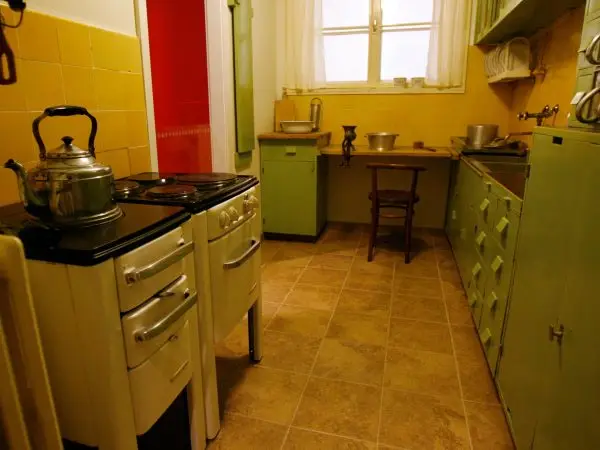
…and two decades later the world’s first fitted kitchen ‘The Frankfurt Kitchen’
In 1919 Hoosier cabinets were imported from the USA, a modular piece of furniture designed for efficiency – combining elaborate storage systems and worktop in one piece, the cutting edge of kitchen furniture design.
Meanwhile, an educational and social movement to raise the status of housework was also imported from America, where women like Christine Frederick were advocating for efficiency in everything from nutrition to childrearing to household design, publishing in 1919 Household Engineering: Scientific Management in the Home.
In 1926 Austrian architect Margarete Schütte-Lihotzky (an astonishing woman, who joined the Nazi resistance) designed the world’s first fitted kitchen ‘The Frankfurt Kitchen’ – with features that are now familiar: ‘continuous countertops, built-in cabinets and drawers optimised for storage, a tiled splashback – all designed as a complementary whole…it was the first mass-produced built-in kitchen, requiring great technical expertise, as well as a forward-looking space that sought to free up women’s time for a life beyond the slog of domesticity.’ Along with Frederick, Schütte-Lihotzky describes the kitchen as a ‘laboratory’.
The English Rose, Modern Materials and more…
‘It was really only after World War Two that kitchens took on a recognisably modern form’ says historian Lucy Woslely ‘The two World Wars had removed the huge infrastructure of servants who’d cooked and cleaned for the Victorians…What the happy 1950s housewife needed instead was a rational, efficient, time-saving, fitted kitchen.’
Following in the footsteps of The Frankfurt Kitchen, ‘One of the early home-grown British fitted kitchen designs was ‘The English Rose’ of 1948, intended to use up the aluminium which had been stockpiled for building Spitfires. You simply chose your whole kitchen from the standard range of units and cupboards. The work surfaces would be covered with coloured, wipe-clean melamine. After the dingy war years, it would look striking, clean and bright.
Electricity was nationalised in 1947, and the post-War relaxation of the hire-purchase rules made gadgets and appliances suddenly became much more obtainable. ‘Choosing your cooking stove’, the housewife was advised, ‘is a momentous event second only to choosing your life partner’. By the mid-1960s, 61% of London households would have a refrigerator.’
The materials used in these kitchens in the 1950s were pioneering. They were a new generation of manmade products, hard surfaces that could be wiped clean – laminate, fibreglass and plastics, stainless steel, enamelled steel and aluminum. Freestanding mis-matched furniture was eschewed – a relic of the past – this thrusting, post- War period was about embracing modernity, colour too, bold, bright hues – mint green, scarlet red and lemon yellow. It is also the start of the kitchen island, placing food preparation at the centre of the room.
Concurrently Scandinavian design with natural materials, neutral palettes, craftsmanship, and clean architectural lines, was in the ascendancy. There is some crossover with the Mid-Century Modern movement emerging from North America, though these kitchens had a softer, calmer, feel to them – they had an enduring, timeless quality, not rooted in fads and fashions.
Over the course of the next decade or so colourways changed, think avocado, purple and orange of the 1970s, but really the mid-century aesthetic in various guises persisted. Cooking and socialising started to be activities enjoyed together. There was near universal adoption of basic appliances.
The 80s – countryside chic (thanks to Brideshead Revisited tv adaptation in 1981?) Provence (Floyd On France perhaps Raymon Blanc too), IKEA, Laura Ashley vs monochrome, minimalism, Memphis Milano, gadgets and gizmos …so many disparate influences.
Pluck-Kitchen-History-22jpg
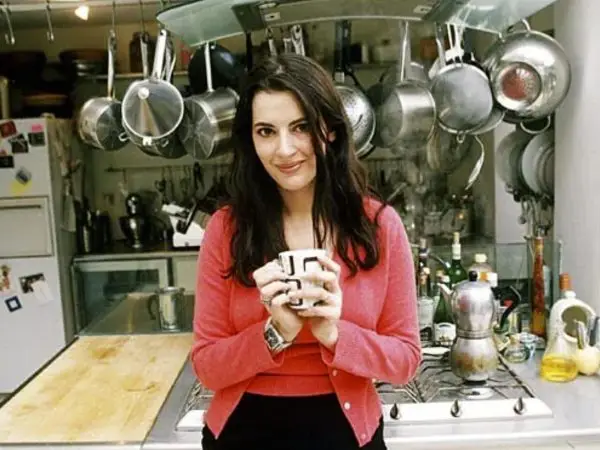
Nigella in her kitchen in the 1990s
The 90s – Nigella
‘Ultimately, Nigella’s 1990s kitchen, like her cooking, was not about attaining perfection, it was about bringing people together. It was the ease with which she welcomed family and friends to gather around her kitchen island while she got on with whatever she was chopping, stewing or roasting that helped get us away from the performative style of hosting the previous generation had bought into. To her, the kitchen was the true heart of the home where everyone was welcome to hang out, no matter how messy things got. That idea has continued to guide homeowners in how they approach design decisions, with the open-plan kitchen and its gargantuan island reigning supreme as one of the most sought after renovation projects.
Now…
Says Leila Touwen Pluck Co-founder…
‘It feels like we are now experiencing a truly creative, exciting and confident moment in British kitchen design, merging many of the best aspects from previous eras, whilst embracing the advantages of our epoch – appliances at their most efficient, beautifully made materials, sustainability. There is a confidence that our clients have, thanks to the personal research that is possible online. to explain their personal taste…the democratisation of kitchen design to a degree.’
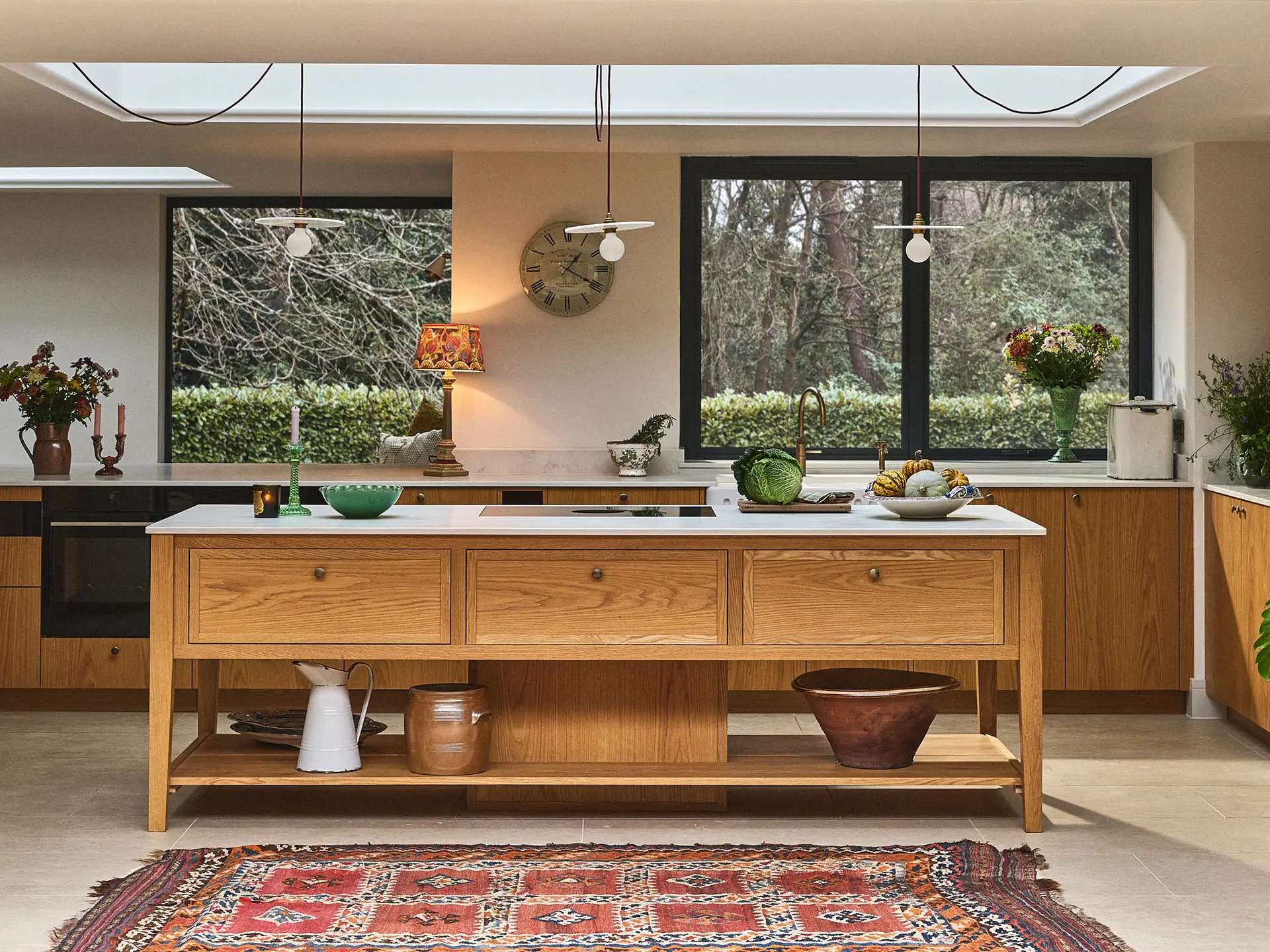
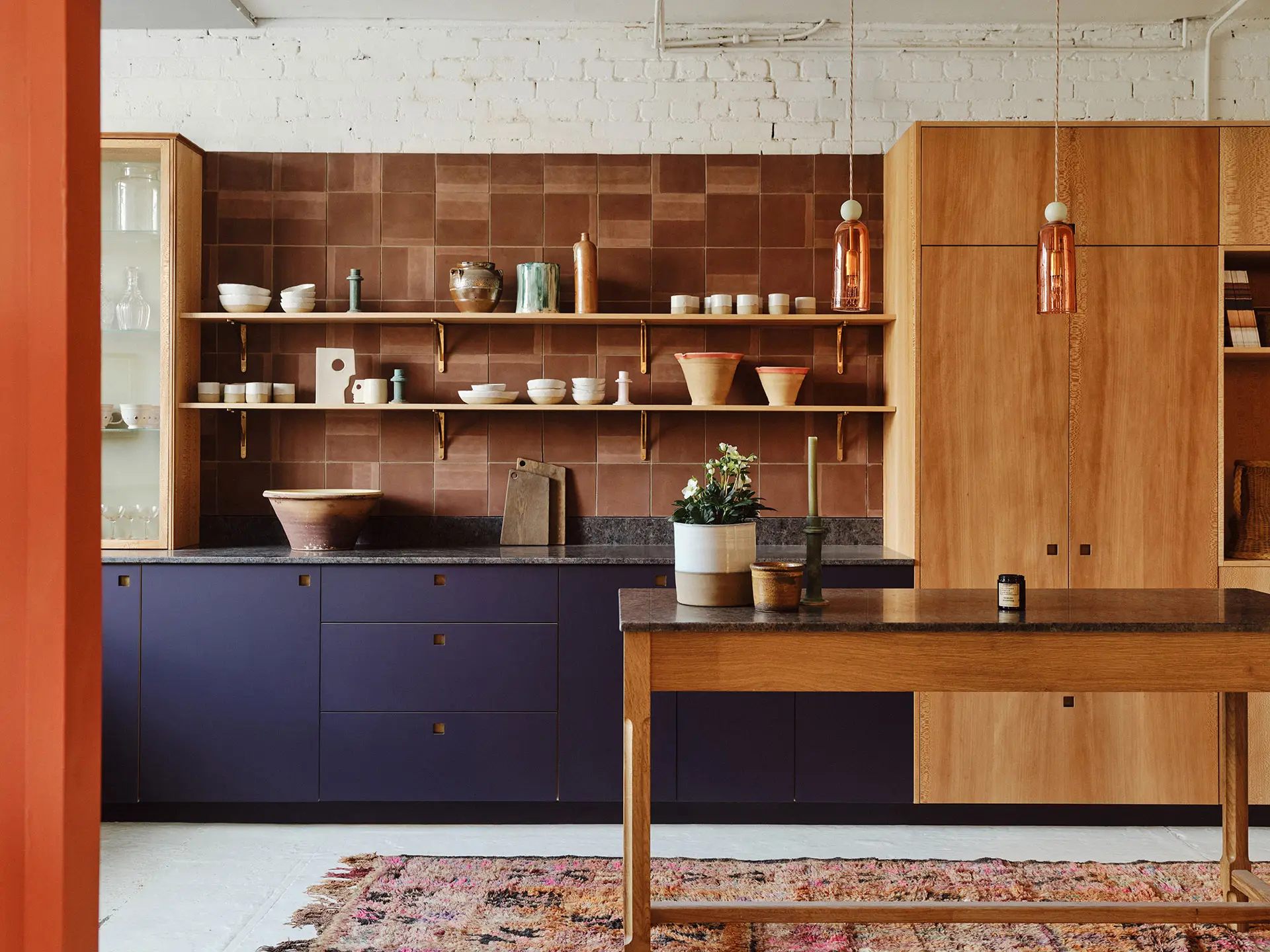
The cabinetry and furniture – certainly at Pluck – takes the best from eras. The utilitarian sensibility of Georgian furniture and also mid-century Scandinavian design, ultimately successful kitchen design is about function, furniture needs to be practical and sturdy…but without looking chunky, the proportions are so important.
Craft is celebrated, the number of skilled hands involved in making a Pluck kitchen is immense, yet we are also able to draw on digital manufacture, giving a precision that is suited to making custom cupboards’.
This roundup has just scratched the surface, there’s some fascinating info out there on the history of kitchens, wonderful period properties to visit and more…I really do hope this has inspired a further dig!
Finally, please enjoy some synergy between Pluck’s designs and older pieces…
*Friendly disclaimer* – although a passion for all things old, we’re not professional historians! Having scoured books, websites, journals and more, we did find little differences in some of the info published, so please do let us know if you think any of these facts and figures could do with tweaking! Where possible we have used trusted sources, quoting and attributing where necessary. For a list of references (perfect for further reading) click here.
This month marks the return to school, classrooms back to bustling and playgrounds raucous so we thought this is the perfect time to give our own little lesson in the history of the kitchen!
I’m not a historian (shocker) and this subject is absolutely immense, but I hope you enjoy this chance to step back in time and chronologise some significant moments in how kitchens have evolved…
Fire and Foraging
For several hundred years, the average cooking set-up did not change a great deal. Can this one room be called a kitchen?! Discuss…
‘The kitchen came from very humble beginnings in the Middle Ages, where peasants lived in one room which served as a room for cooking, eating and general living. The kitchen really consisted of a hearth stone, a smoky wood fire with a pot on top and a wooden spoon. This was used from as far back as the Saxons right up to the time of the Tudors…Food was foraged so the diet was seasonal and quite limited. Bread was not cooked at home but in the oven of the Lord of the Manor along with the bread of all of the other peasants.’ explains The Victorian Emporium.
The kitchens in the wealthy, bread baking households often had several huge fireplaces and spits for cooking and roasting meat. They would be separate from the Great Hall, the main space to host and show off your power and status, reflecting the vernacular architecture of the day, decorated with works from the favoured tapestry weaver or painter.
Stuart Kitchens and Coal
The major development during this era was the introduction of coal as a cooking fuel, in part precipitated by wood shortages. Open hearths were inefficient for burning coal, which requires a concentrated updraft to stay lit, so these were redesigned. Over the course of the 17th century, the open hearth began evolving into early versions of the enclosed iron range to better manage coal’s intense, concentrated heat.
Food tasted different, cooking was easier with less smoke and time was freed up as the laborious task of keeping a wood fire burning was no longer needed…but only for servants in the wealthiest households at this point.
The scents emanating from grand kitchens were changing too as new flavours and cooking fads were embraced. France was considered a bastion of culinary excellence.
Pluck-Kitchen-History-13
Burghley House 16th Century Kitchen
Georgian Furniture and Cast Iron Ranges
The emergence of the middle-class merchants is when the typical domestic set-up starts to shift significantly. Emulating noble houses, kitchens are downstairs out of sight. Cooking, food prep and storage separated with sculleries and pantries. The aristocratic notion that kitchens were best avoided, cooking and the rest, is servants’ work was embraced by those making enough money to do so.
The coal revolution continues and contributes to the invention of the first ever range cooker at the very end of this period in 1829 by William Flavel. A huge change, goodbye to open-fire cooking, hello to hob rings and an oven in a single iron unit, though only available to the wealthiest people to begin with…
This is the time when furniture makers became famous and sought after for their craft, with workshops that employed hundreds of skilled craftsmen. Thomas Chippendale blazed the trail and was the first cabinetmaker to publish a book of their designs The Gentlemen and Cabinet Makers Director. Furniture and cabinet making is no longer the preserve of anonymous craftsmen working under a strict guilds system.
These expensive, fashionable pieces may not have been found in utilitarian kitchens nor worker’s homes but they did set the tone for the era. Craftsmanship, elegant proportions, beautifully functional – dressers, cabinets and work tables in Georgian kitchens – are quite simply exquisite…which leads nicely onto our next topic…
Pluck-Kitchen-History-14
Lanhydrock House Victorian Country Kitchen
Upstairs Downstairs
A kitchen history wouldn’t be complete without looking at the kitchens of grand houses. These culinary engine rooms with their skilled cooks that nourished the inhabitants of noble houses were incredibly well designed with large central tables, dressers, cast iron hearths, copper pans and ceramics for serving. Along with the main room for cooking, typically there was a scullery for washing pots and pans, a larder for keeping fresh meat cool and a pantry for food storage.
Historian David J. Eveleigh notes ‘in September 1833, Walcot House, a large house overlooking the London Road in Bath was sold by auction…the particulars described it as , ‘a most comfortable and gentlemanly residence…The basement contained beer and coal cellars, cellars for port wine and Madeira, a housekeeper’s room, a ‘spacious brew house’ and ‘a good roomy kitchen with area, steps and back entrance, improved smoke jack and range, stew holes, dresser and shelves’. The adjoining scullery had a stone trough and water supply.’ These particulars, he writes, ‘would be repeated for many large in both town and country in the eighteenth and nineteenth centuries….though the scale would differ, with large country houses offering more space and rather than being relegated to the basement, they may be placed discretely to the north of the main block.’
‘The floors of large working kitchens were generally stone flagged. Walls were usually painted cream although some were a deep blue – a colour which is, apparently, repellent to flies. Skirtings, door and window frames were often finished in a dark brown whilst the furniture including the dresser was usually cream or buff – or ‘drab’’.
Mrs Beeton and the Industrial Revolution
Journalist and author Mrs Beeton was an influencer of her day, aspirational Victorians looked to her for advice on how to run their households. In 1861’s Mrs Beeton’s Book of Household Management, a top seller, she said ‘A good kitchen should be sufficiently remote from the principal apartments of the house, that the members, visitors, or guests of the family, may not perceive the odour incident to cooking, or hear the noise of culinary operations’.
Take a moment to contrast with this, for working class Victorians the kitchen doubled as the bathroom. Once a week or so, the tin bath was hauled in from outside, filled using buckets and set-up by the hearth for maximum warmth…there was a vast gap between rich and poor.
The industrial revolution accelerated change – urbanisation, slums, consumerism, pollution, scientific breakthroughs, cleanliness – all reflected in kitchens.
We take clean water for granted in our homes, but in the second half of the nineteenth century the transition to indoor plumbing transformed daily domestic life (and public health)…the daily grind of going to the public pump no longer required.
The range cooker was refined and developed from the original 1829 model so smokey open hearths became a thing of the past. Concurrently, the first gas cookers were on the market and in 1882, Canadian Thomas Ahearn invented the electric oven, though it didn’t really take off until 40 or so years later.
Factories began mass manufacturing items such as measuring cups, glass canning jars, cookbooks and name-brand commercially produced ingredients…the items in kitchen cupboards and on shelves were changing. Think about the reaction to mass manufacture by cultural figure, textile designer and social activist William Morris who famously said ‘Have nothing in your home which you do not know to be useful, or believe to be beautiful.’
In terms of kitchen furniture, actually the pieces themselves remained pretty similar to the Georgian previous era – scullery dressers, work tables, pantry cupboards and shelves. Taste and fashion meant styles changed, this era tends to be associated with heavier, more decorative pieces, but the on-trend pieces would not be found in kitchens, this was the place for utilitarian items.
The pace of change was only going to get speedier for kitchen design…
Electricity, Home Economics and the Early 20th Century
Edwardian era kitchens tended to be a continuation of the previous century – upstairs-downstairs, an increasingly comfortable middle-class mimicked the nobility’s set-up but on a smaller scale, with drastically different home lives for the working classes, who began to protest.
The World Wars dismantled the social structure as it was, large country houses were requisitioned for use in the war effort, domestic staff enlisted or worked elsewhere, for example, in munitions factories. The economies of running big estates were bust – houses fell into decay and along with it their grand kitchens. The nation’s relationship to food changed due to rationing amid severe shortages.
It is hard to believe it but in 1919, only 6% of homes had electricity, which increased to two thirds by the end of the 1930s. Along, with lighting this precipitated a revolution in appliances – everything was becoming more convenient. Of course one of the major inventions was the fridge, but actually there is so much going on it is hard to not write a thesis. This was an era that juxtaposes the old world with the new…
Pluck-Kitchen-History-05
Annie Louise Freeman and two colleagues in the Palace House kitchen in 1905
Pluck-Kitchen-History-06
…and two decades later the world’s first fitted kitchen ‘The Frankfurt Kitchen’
In 1919 Hoosier cabinets were imported from the USA, a modular piece of furniture designed for efficiency – combining elaborate storage systems and worktop in one piece, the cutting edge of kitchen furniture design.
Meanwhile, an educational and social movement to raise the status of housework was also imported from America, where women like Christine Frederick were advocating for efficiency in everything from nutrition to childrearing to household design, publishing in 1919 Household Engineering: Scientific Management in the Home.
In 1926 Austrian architect Margarete Schütte-Lihotzky (an astonishing woman, who joined the Nazi resistance) designed the world’s first fitted kitchen ‘The Frankfurt Kitchen’ – with features that are now familiar: ‘continuous countertops, built-in cabinets and drawers optimised for storage, a tiled splashback – all designed as a complementary whole…it was the first mass-produced built-in kitchen, requiring great technical expertise, as well as a forward-looking space that sought to free up women’s time for a life beyond the slog of domesticity.’ Along with Frederick, Schütte-Lihotzky describes the kitchen as a ‘laboratory’.
The English Rose, Modern Materials and more…
‘It was really only after World War Two that kitchens took on a recognisably modern form’ says historian Lucy Woslely ‘The two World Wars had removed the huge infrastructure of servants who’d cooked and cleaned for the Victorians…What the happy 1950s housewife needed instead was a rational, efficient, time-saving, fitted kitchen.’
Following in the footsteps of The Frankfurt Kitchen, ‘One of the early home-grown British fitted kitchen designs was ‘The English Rose’ of 1948, intended to use up the aluminium which had been stockpiled for building Spitfires. You simply chose your whole kitchen from the standard range of units and cupboards. The work surfaces would be covered with coloured, wipe-clean melamine. After the dingy war years, it would look striking, clean and bright.
Electricity was nationalised in 1947, and the post-War relaxation of the hire-purchase rules made gadgets and appliances suddenly became much more obtainable. ‘Choosing your cooking stove’, the housewife was advised, ‘is a momentous event second only to choosing your life partner’. By the mid-1960s, 61% of London households would have a refrigerator.’
The materials used in these kitchens in the 1950s were pioneering. They were a new generation of manmade products, hard surfaces that could be wiped clean – laminate, fibreglass and plastics, stainless steel, enamelled steel and aluminum. Freestanding mis-matched furniture was eschewed – a relic of the past – this thrusting, post- War period was about embracing modernity, colour too, bold, bright hues – mint green, scarlet red and lemon yellow. It is also the start of the kitchen island, placing food preparation at the centre of the room.
Concurrently Scandinavian design with natural materials, neutral palettes, craftsmanship, and clean architectural lines, was in the ascendancy. There is some crossover with the Mid-Century Modern movement emerging from North America, though these kitchens had a softer, calmer, feel to them – they had an enduring, timeless quality, not rooted in fads and fashions.
Over the course of the next decade or so colourways changed, think avocado, purple and orange of the 1970s, but really the mid-century aesthetic in various guises persisted. Cooking and socialising started to be activities enjoyed together. There was near universal adoption of basic appliances.
The 80s – countryside chic (thanks to Brideshead Revisited tv adaptation in 1981?) Provence (Floyd On France perhaps Raymon Blanc too), IKEA, Laura Ashley vs monochrome, minimalism, Memphis Milano, gadgets and gizmos …so many disparate influences.
The 90s – Nigella
Pluck-Kitchen-History-22jpg
Nigella in her kitchen in the 1990s
‘Ultimately, Nigella’s 1990s kitchen, like her cooking, was not about attaining perfection, it was about bringing people together. It was the ease with which she welcomed family and friends to gather around her kitchen island while she got on with whatever she was chopping, stewing or roasting that helped get us away from the performative style of hosting the previous generation had bought into. To her, the kitchen was the true heart of the home where everyone was welcome to hang out, no matter how messy things got. That idea has continued to guide homeowners in how they approach design decisions, with the open–plan kitchen and its gargantuan island reigning supreme as one of the most sought after renovation projects.
Now…
Says Leila Touwen Pluck Co-founder…
‘It feels like we are now experiencing a truly creative, exciting and confident moment in British kitchen design, merging many of the best aspects from previous eras, whilst embracing the advantages of our epoch – appliances at their most efficient, beautifully made materials, sustainability. There is a confidence that our clients have, thanks to the personal research that is possible online. to explain their personal taste…the democratisation of kitchen design to a degree.’
The cabinetry and furniture – certainly at Pluck – takes the best from eras. The utilitarian sensibility of Georgian furniture and also mid-century Scandinavian design, ultimately successful kitchen design is about function, furniture needs to be practical and sturdy…but without looking chunky, the proportions are so important.
Craft is celebrated, the number of skilled hands involved in making a Pluck kitchen is immense, yet we are also able to draw on digital manufacture, giving a precision that is suited to making custom cupboards’.
This roundup has just scratched the surface, there’s some fascinating info out there on the history of kitchens, wonderful period properties to visit and more…I really do hope this has inspired a further dig!
Finally, please enjoy some synergy between Pluck’s designs and older pieces…
*Friendly disclaimer* – although a passion for all things old, we’re not professional historians! Having scoured books, websites, journals and more, we did find little differences in some of the info published, so please do let us know if you think any of these facts and figures could do with tweaking! Where possible we have used trusted sources, quoting and attributing where necessary. For a list of references (perfect for further reading) click here.